
A jar of pumpkin seeds lives on my desk, and for months I ate from it out of boredom, with zero thought about minerals.
One evening I checked USDA figures and found that 100 g of dried pumpkin seed kernels contain 8.82 mg of iron, close to half of the 18 mg a woman aged 19 to 50 needs in a day by NIH numbers.
That number sent me into food tables and absorption papers from the 1980s, and yeah, it got nerdy fast.
Word lovers get a small gift here: iron’s chemical symbol, Fe, comes from Latin ferrum, and the same root lives on in “ferritin” (the protein that stores iron in the body).
Seeds win, mostly. Sesame tops my list at 14.6 mg per 100 g, while some nuts people buy for health reasons land near the bottom with under 3 mg.
Why iron from seeds is a harder catch
An adult body contains about 3 to 4 g of iron, and most of it is in hemoglobin, the protein in red blood cells that moves oxygen around. Food iron comes in two forms.
Meat, poultry and seafood supply heme iron with some nonheme iron mixed in, while plants supply only nonheme iron (the form gut absorbs less well, and the one other foods on a plate can block).
How big is that gap? The NIH Office of Dietary Supplements puts absorption at about 14% to 18% from mixed Western diets and 5% to 12% from vegetarian diets. For that reason it sets the vegetarian RDA 1.8 times higher.
Standard RDAs from that fact sheet: 8 mg a day for men, 18 mg for women aged 19 to 50, 27 mg in pregnancy and 8 mg for adults over 51.
UK figures from NHS differ a little, at 8.7 mg for men and 14.8 mg for women aged 19 to 49. Two compounds in nuts and seeds work against uptake: phytate (a phosphorus store in seeds that binds minerals) and polyphenols. Vitamin C and meat push in the other direction.
Low iron rarely shows up overnight.
NIH describes three stages: stores run down first, the body moves next into iron-deficiency erythropoiesis (red blood cell production on a short iron supply), and anemia appears only at the end.
Pregnancy is where the numbers jump.
In US survey data from 1999 to 2006, 18% of pregnant women had iron deficiency, from 6.9% in the first trimester up to 29.7% in the third.
15 Nuts and seeds highest in iron, ranked:
My figures for this list come from USDA FoodData Central, per 100 g and per 1 ounce (28 g), for raw or dried products unless I say otherwise.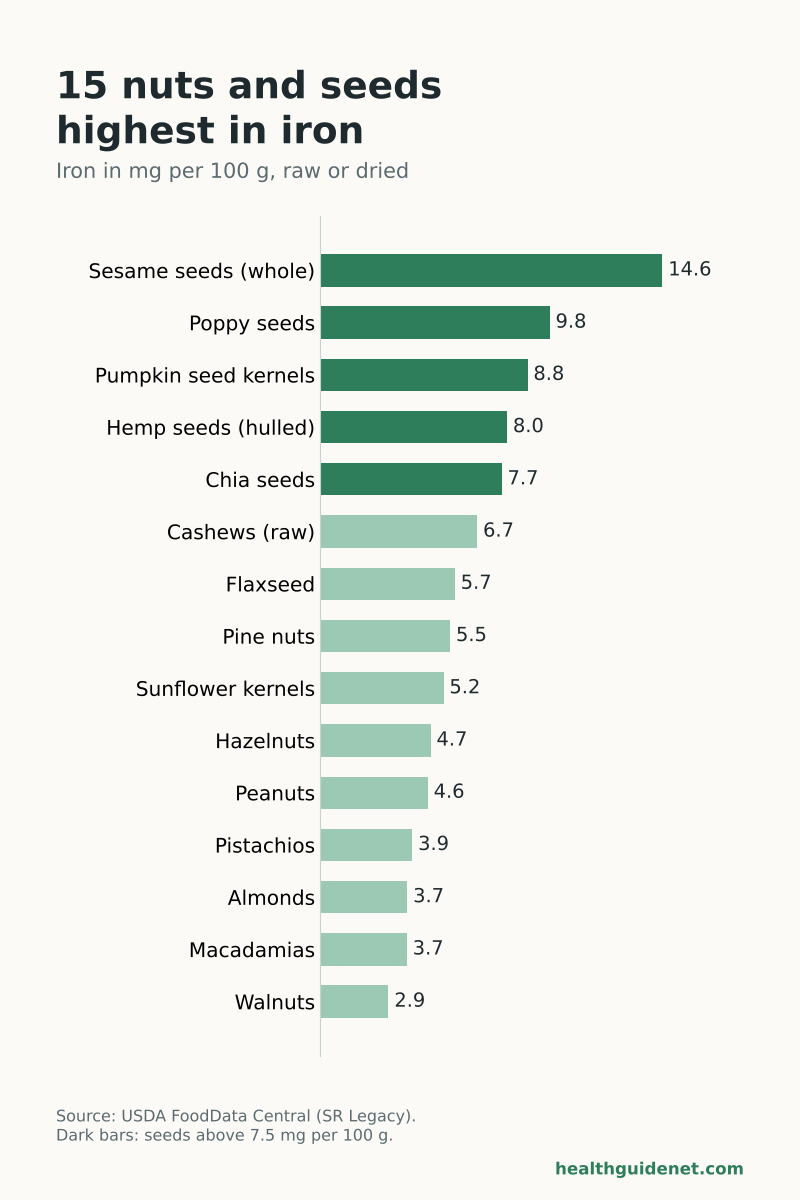
Order follows iron per 100 g, with the ounce figure next to it for real life.
#1 Sesame seeds (14.6 mg per 100 g)
Whole dried sesame seeds contain 14.55 mg of iron per 100 g, about 4.1 mg per ounce. Hull status matters a lot. Hulled sesame kernels drop to about 6.4 mg per 100 g in the same database, so a jar of whitish hulled seeds and a jar of whole tan ones are not equal.
Few people eat an ounce of loose sesame in one go, so tahini is how I get it in: 100 g of tahini from roasted kernels has about 9 mg, which works out near 2.7 mg in two tablespoons.
#2 Poppy seeds
Poppy seeds have 9.76 mg of iron per 100 g. A tablespoon weighs about 8.8 g, so a real sprinkle on a bagel comes to 0.86 mg. Same 100 g also packs 1,438 mg of calcium, and the NIH notes that calcium might reduce absorption of both iron forms, though that effect is not firmly established.
#3 Pumpkin seed kernels
Dried pumpkin seed kernels (pepitas) have 8.82 mg per 100 g, roughly 2.5 mg per ounce.
Roasted kernels come in at about 8.1 mg.
Whole roasted seeds with shells on are a separate entry in nutrition tables, at about 3.3 mg per 100 g, so check what bag says. Those green kernels are what fill the jar from my first paragraph.
#4 Hemp
Hulled hemp seed lists 7.95 mg of iron per 100 g. Three tablespoons, about 30 g, come to roughly 2.4 mg. Texture is nutty and a bit chewy, and the seeds go into oatmeal with no prep at all, which is why I like them most of the mornings.
#5 Chia
Dried chia seeds contain 7.72 mg per 100 g and about 2.2 mg per ounce.
In milk or water they swell into a gel, the base of chia pudding, so I never eat them as dry spoonfuls. For the less pleasant side, there is a separate piece on chia seeds side effects in females.
ALSO READ: Vegan Foods High In Iron To Fight Iron Deficiency
#6 Cashews
Raw cashews have 6.68 mg of iron per 100 g, the highest true nut here. An ounce of raw cashews comes to about 1.9 mg, and a dry-roasted ounce is closer to 1.7 mg. I use cashews in sauces more than as a snack (blended, they vanish into a cream).
#7 Flaxseed
Flaxseed has 5.73 mg per 100 g. Ground flax at 28 g comes to about 1.6 mg, though a spoonful in a smoothie weighs far less than 28 g.
#8 Pine nuts
Dried pine nuts have 5.53 mg per 100 g, or about 1.6 mg per ounce. They cost a lot. Most of people buy them for pesto by the small bag, so the iron in a real portion stays modest. In a dry pan they brown in a minute or two, so I watch them closely.
#9 Sunflower kernels
Dried sunflower kernels list 5.25 mg per 100 g. Dry roast changes the figure: the dry-roasted unsalted version shows about 3.8 mg per 100 g, so a roasted ounce comes to roughly 1.1 mg.
They are cheap and easy to scatter on soup.
#10 Hazelnuts
Hazelnuts have 4.70 mg per 100 g, about 1.3 mg per ounce, and they were one of the nuts in the 1988 bread meals as well. They also went through a 2020 lab test on soaked nuts, which I come back to in next section.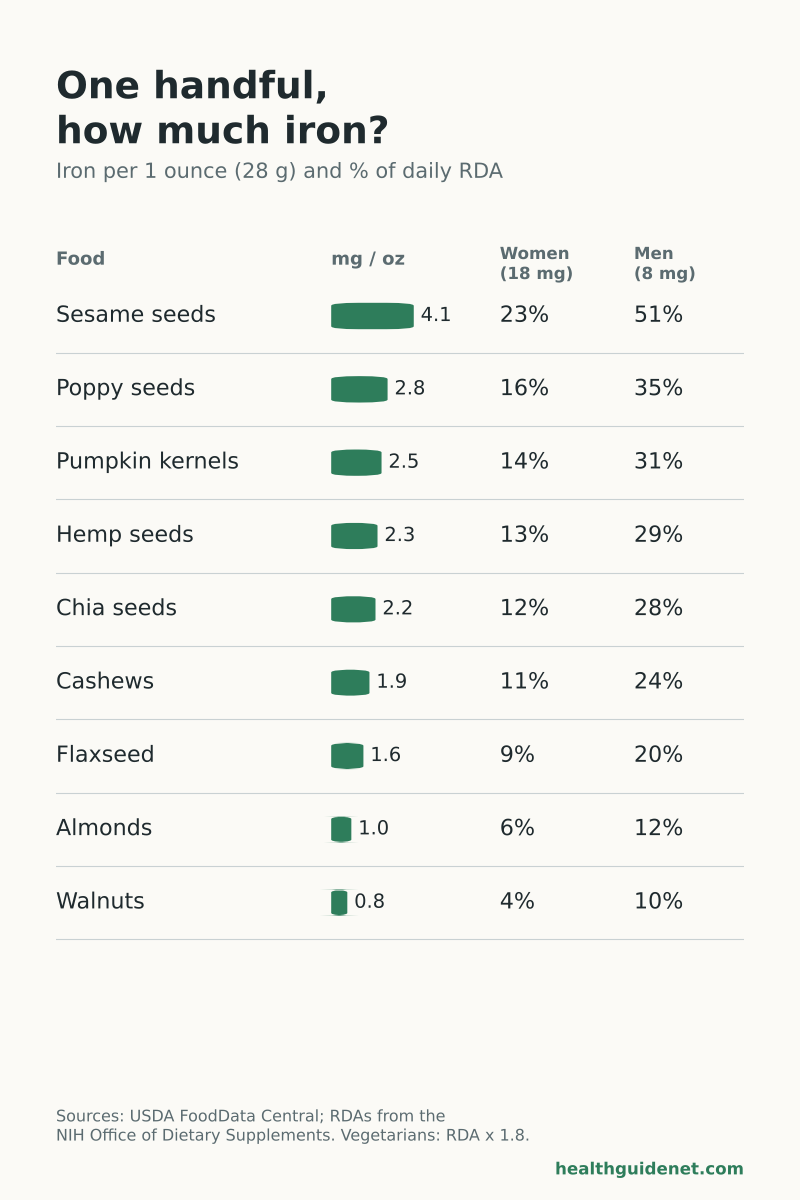
#11 Peanuts
Peanuts are legumes, but snack aisles file them with nuts.
They have 4.58 mg per 100 g and about 1.3 mg per ounce. For a lighter side trip, here is how many peanuts go into a jar of peanut butter.
#12 Pistachios
Pistachios contain 3.92 mg per 100 g, close to 1.1 mg per ounce.
#13 Almonds
Raw almonds have 3.71 mg per 100 g, about 1.0 mg per ounce. Almonds were in both the 1988 bread meals and the 2020 soak work. Iron is not their strong suit. Vitamin E is, and there is more on that in a list of foods high in vitamin E.
#14 Macadamias
Macadamias land almost level with almonds at 3.69 mg per 100 g, about 1.0 mg per ounce. For me they are a treat food.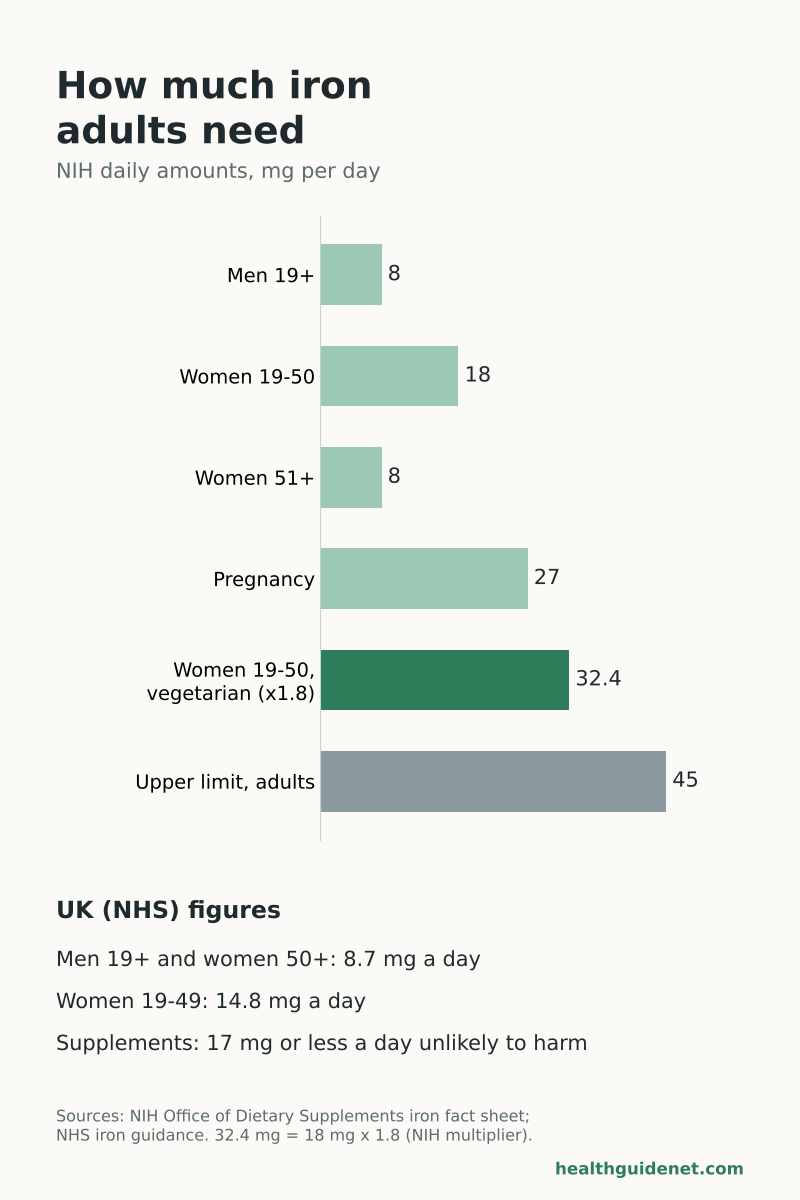
#15 Walnuts
English walnuts have 2.91 mg per 100 g and about 0.8 mg per ounce. They made the cut for a 2020 soak study and for a 1988 absorption trial.
What four studies say about nut iron uptake
Content tables measure what is in the food. How much of it reaches blood is a separate question, and the best human data on nuts dates from 1988.
In a 1988 absorption trial published in the American Journal of Clinical Nutrition, researchers in South Africa measured iron uptake in 137 Indian women.
Bread meals with walnuts, almonds, peanuts or hazelnuts produced a mean absorption of 1.8%, against 6.6% from bread alone.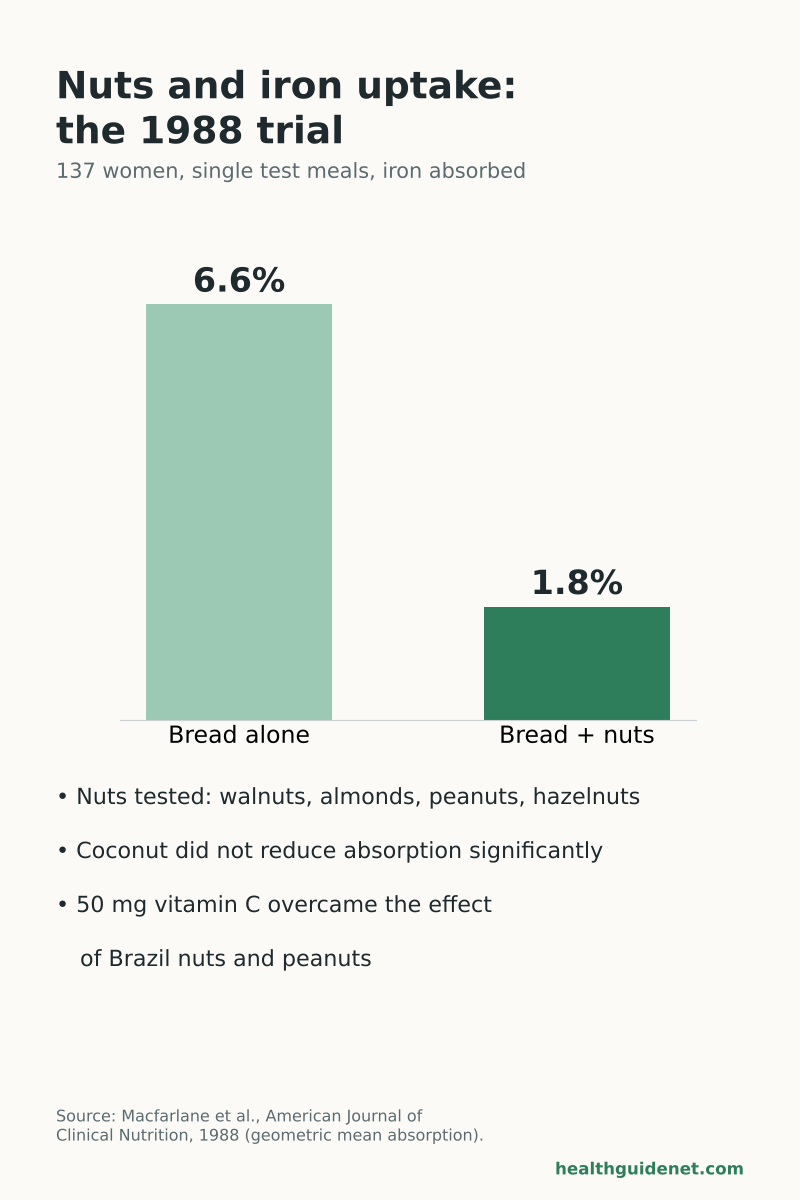
Coconut did not reduce absorption significantly, and it contained far less phytate and polyphenol than the other nuts tested. When the team added 50 mg of vitamin C, it overcame the inhibitory effect of the two nuts tested that way (Brazil nuts and peanuts).
It is a landmark paper with clear limits: single test meals, and no measure of long-term iron stores.
Does that mean vegetarians end up short? A 2018 systematic review and meta-analysis in Critical Reviews in Food Science and Nutrition pooled 24 cross-sectional studies and found that adult vegetarians had significantly lower serum ferritin (a blood marker of iron stores) than non-vegetarians, with a bigger gap in men than in women.
The authors concluded that vegetarians “are more likely to have lower iron stores.” All of the pooled data was cross-sectional, so this is an association, and it says nothing about which seeds or nuts anyone ate.
A fix that circulates online is to “activate” nuts with an overnight soak. A 2020 study in Food Chemistry tested this in a lab, with whole and chopped almonds, hazelnuts, peanuts and walnuts put through several soak regimes, and the phytate changes were small (from 12% lower to 10% higher than untreated nuts), while mineral concentrations generally went down after the soak, chopped nuts most of all, and phytate-to-mineral ratios did not improve.
No people were in it, only nut samples. Still, it answers the question for anyone who spends an evening on a soak routine.
Vitamin C is the other piece of folk advice. A 2020 randomized trial in JAMA Network Open assigned 440 adults with iron deficiency anemia (426 of them women, mean age 38.3) to 100 mg of oral iron three times a day, 8 hours apart, with or without 200 mg of vitamin C, for three months.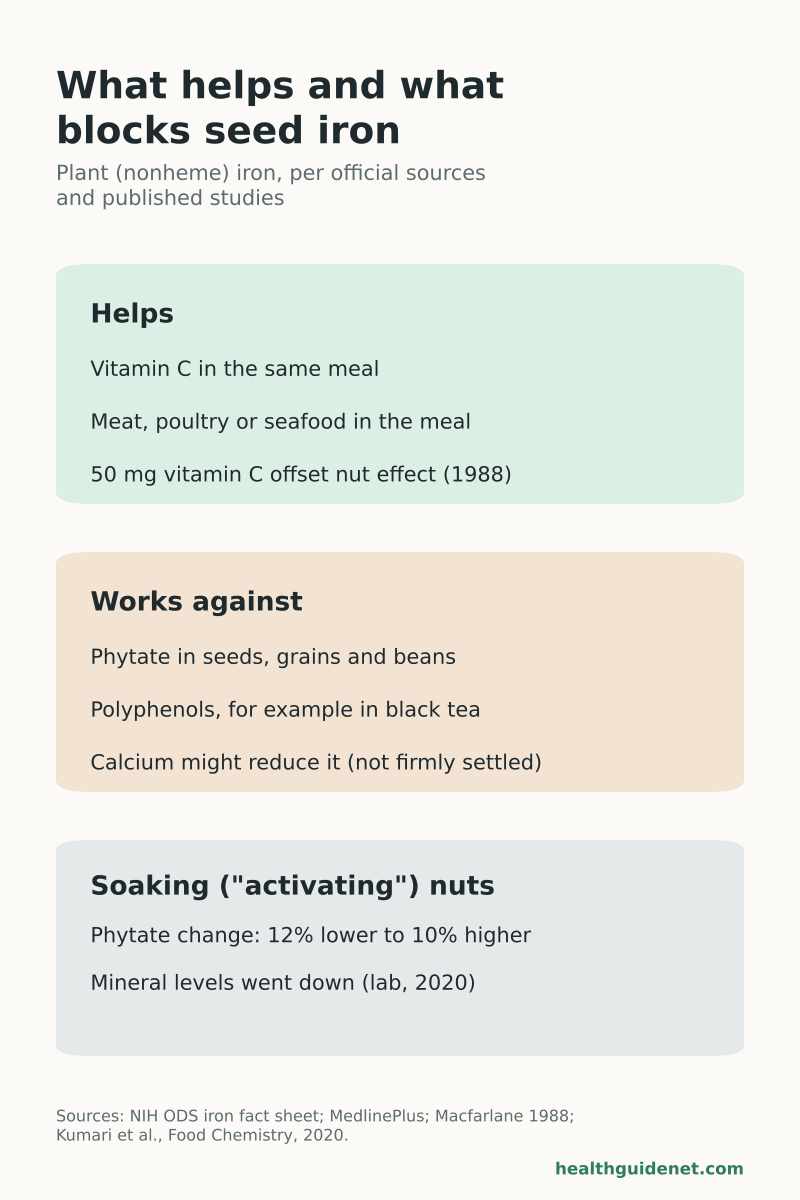
After two weeks, hemoglobin went up by 2.00 g/dL with vitamin C and 1.84 g/dL without, a gap that met the authors’ criteria for equivalence. At eight weeks, ferritin had increased by 35.75 and 34.48 ng/mL.
Those were supplement doses in an open-label, single-center trial with very few men, so for a seed snack the 1988 meal data looks more relevant to me.
How I would put a handful to work
Iron from seeds asks for a bit of thought.
I add something with vitamin C to the same meal, like a few strawberries on chia pudding or a squeeze of lemon over a tahini dressing, because the 1988 trial in the section above found that 50 mg overcame the nut effect in single meals (there is a full list of foods high in vitamin C if citrus bores you).
Tea moves to a different hour.
MedlinePlus says black tea contains substances that bind iron, and the NIH lists polyphenols with the inhibitors, so my mug waits until mid-afternoon on days when lunch is a seed bowl.
A cast-iron pan is my small extra. MedlinePlus notes that food prepared in a cast-iron skillet can provide more iron, so I toast pumpkin seeds in one, though I found no data for seeds specifically.
If you eat meat or fish, NIH notes that those foods raise nonheme iron absorption from the rest of the plate, so a spoon of pumpkin seeds over a salmon salad earns its place.
Variety helps more than loyalty to one seed. Pumpkin and hemp go into breakfast, sesame arrives as tahini, flax lands in a smoothie and cashews end up in a sauce. Why bother? The list two sections up shows it: an ounce of any of the top five seeds comes to between 2.2 and 4.1 mg, while an ounce of walnuts stays under 1 mg.
Vegetarians and vegans start from the 1.8 multiplier, which puts a woman aged 19 to 50 near 32 mg a day on paper. Seeds alone rarely cover that.
How much a person absorbs depends of their stores, their meals and their health, so a GP or registered dietitian is a better guide than any list. My nuts go straight from bag to bowl now, with no soak.
Allergies, calories and iron pills
Peanuts and tree nuts are major food allergens in the US, and since January 1, 2023, FDA rules on sesame labels require packaged foods to declare sesame as an allergen. Anyone with a nut or seed allergy should avoid the foods they react to, whatever the iron content.
Seeds are also dense in energy. In USDA data, 100 g of dried pumpkin seed kernels has about 559 kcal, so a desk jar is easy to overdo.
Food iron rarely causes trouble. Supplements are a separate matter.
The NIH sets the upper limit at 45 mg a day for adults, pregnancy and breastfeeding included, and NHS guidance says 17 mg or less of supplemental iron a day is unlikely to cause harm, while doses over 20 mg can cause constipation, nausea, vomiting and stomach pain.
Iron can reduce how well levothyroxine and levodopa work, and proton pump inhibitors, which lower stomach acid, reduce iron uptake, so people on those medicines should ask a pharmacist or doctor before they add iron.
People with hemochromatosis (a genetic condition that makes the body absorb excess iron) should not take iron supplements. During pregnancy the RDA is 27 mg, and any supplement belongs in a talk with a doctor or midwife.
Children are the serious case. US labels on solid iron supplements must warn that accidental overdose of iron products is one of the main causes of fatal poisoning in children under 6, so the bottle stays out of reach.
When to see a doctor about low iron
NHS advice is to see a GP when someone suspects iron deficiency anemia. The most common signs on the NHS list are tiredness with a lack of energy and shortness of breath, next to heart palpitations, paler skin and headaches.
NIH puts the anemia cutoff at hemoglobin below 13 g/dL in men and 12 g/dL in women.
Less common signs include pica (cravings for non-food items such as ice or paper), restless legs, spoon-shaped nails and hair loss.
Heavy periods and pregnancy are very common causes, per NHS, but bleeding in the stomach or gut, from ulcers or from painkillers such as ibuprofen and aspirin, is on the list as well.
That is why a blood test and a doctor’s look at the cause come before any self-treatment.
Call 911 in the US or 999 in the UK right away if someone has signs of a severe allergic reaction after nuts or seeds: lips, mouth, throat or tongue that suddenly swell, very fast breathing or a struggle to breathe, a tight throat or a hard time when they swallow, or sudden confusion or a faint.
If a child swallows iron tablets, contact emergency services or poison control at once.
Nuts and seeds with the most iron, side by side
| Food or factor | Key number | Source and evidence |
|---|---|---|
| Whole sesame seeds | 14.6 mg per 100 g | USDA, “hull on” matters |
| Poppy seeds | 9.8 mg per 100 g | USDA, tiny real portions |
| Pumpkin kernels | 8.8 mg per 100 g | USDA, dried pepitas |
| Hemp hearts | 8.0 mg per 100 g | USDA, hulled seed |
| Chia seeds | 7.7 mg per 100 g | USDA, seed form |
| Raw cashews | 6.7 mg per 100 g | Top true nut |
| Walnuts | 2.9 mg per 100 g | Last place here |
| Bread with nuts | 1.8% vs 6.6% absorbed | 1988 trial, 137 women |
| 50 mg vitamin C | Offset the nut effect | Single-meal tests, 1988 |
| Soaked nuts | Phytate 12% lower to 10% higher | Lab only, no people |
| Vegetarian iron stores | Lower ferritin | 24 cross-sectional studies, association |
| Vitamin C with iron pills | No extra hemoglobin gain? | “equivalent” in 440-person RCT |
This article is for general information and does not replace advice from a doctor or other qualified health professional.